

In today's world of college athletics, many of the parameters and boundaries that once existed are no longer in place. In many ways, college sports don't even feel like college sports anymore.
On one hand, recent changes to the landscape can be viewed as a good thing. Players can now get paid through NIL and can utilize the transfer portal to find new opportunities. Thus, college sports have never been more player-friendly. On the other hand, the lack of structure has also created plenty of chaos and confusion. Look no further than the back-and-forth eligibility rulings from this summer.
College football eligibility issues continue to be a giant mess
The NCAA doesn't seem to have a solid grasp on who is eligible for the upcoming college football season. Earlier this month, a decision from a U.S. District Court judge in Colorado gave an additional year of eligibility to thousands of athletes in the high school Class of 2022. The move impacted Hoosier defensive linemen Kellan Wyatt and Stephen Daley, who then made plans to return to Bloomington for one more season.
However, that ruling is now on pause after the NCAA won a legal appeal from the United States Court of Appeals for the Tenth Circuit. The NCAA was granted a stay, which put a pause on the eligibility of those players, including Daley and Wyatt. With the season so close to starting up, nobody really knows what is going to happen next.
Taking things a step further, two NFL players have been permitted to return to college football in 2026. Cleveland's Dae'Quan Wright and New Orleans' Zxavian Harris have both decided to part ways with their current NFL teams to join the LSU Tigers. According to ESPN, those moves are made possible thanks to a court order stating that players can regain their college eligibility if they terminate their professional contracts and repay and pro earnings. Pretty wild stuff.
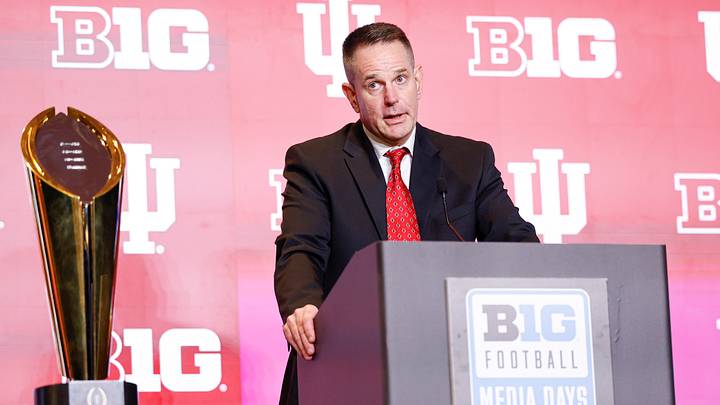
In the wake of Lane Kiffin bringing in two NFL players mere days before the new season gets underway, the Big Ten is set to make a move that aims to bring at least some organization to this mess.
Big Ten won't allow players to return to college from the NFL
It's pretty crazy even writing this, as this problem was never thought to become an issue in college athletics. But here we are.
According to Pete Thamel, the Big Ten is ready to pass a rule that doesn't allow players to return from the NFL and play for one of its schools. Thamel reports that the move wouldn't allow a player to play for a Big Ten team if they have declared for the NFL Draft and did not withdrawn, appeared on an NFL roster, or signed a contract with a professional league.
This is a common sense move from the Big Ten, and other leagues need to follow. In a landscape with so little organization and structure, there needs to be a clear line between what a college and professional football player is. Declaring for the draft, signing a contract, being on an NFL roster, and playing in NFL preseason games should 100% mean that you are not permitted to return to the college game.
Establishing this boundary is a much-needed decision that would bring at least some consistency to a system that is only getting more chaotic by the minute. It doesn't completely solve the problem of eligibility cases and constant court battles, but it is certainly a start.
 Add us as a preferred source on Google