

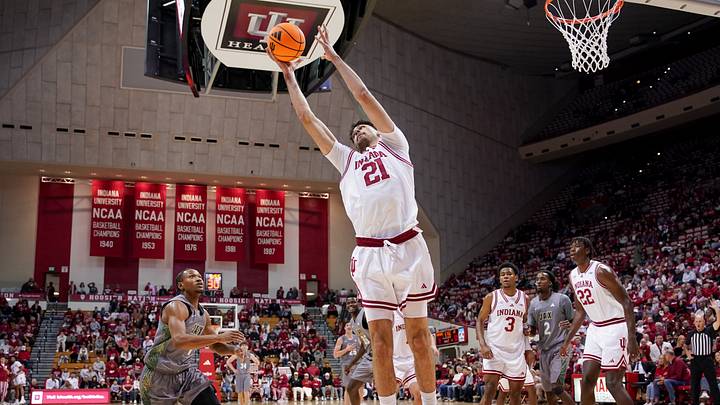
It's still early, but the excitement surrounding the Indiana Hoosiers continues to grow. Darian DeVries' squad is off to a strong 7-0 start and has picked up impressive wins over Syracuse, No. 20 Arkansas, and Kentucky in the process.
For their efforts, the Hoosiers were ranked as the No. 23 team in the country in the latest AP Poll. Indiana faces Bowling Green on Friday before the Big Ten opener against Rutgers on Tuesday, Dec. 1. As the schedule begins to ramp up again, let's take a look at two key areas of improvement that have led the Hoosiers to their fast start in 2026-27.
1. Scoring depth
I've mentioned it a lot on this page, but the Hoosiers entered the offseason needing to find more scoring depth. Last season, the offense was simply too overly reliant on Lamar Wilkerson to put up points. Wilkerson had a great individual season by ranking 2nd in the Big Ten with 20.9 points per game, but only one other Hoosier averaged more than 10 points per game (Tucker DeVries, 13.7). Indiana's stagnant offense and a lack of pace and rhythm made them easy to guard. But so far this season things have been different.
Through seven games, Indiana has shown much more reliable scoring depth than last season. A total of five Hoosiers are averaging double-digit points per game: Darren Harris (14.3), Markus Burton (12.9), Bryce Lindsay (12.9), Aiden Sherrell (12.1), and Samet Yigitoglu (11.0). Jaeden Mustaf is just off the list by averaging 9.9 points per game, but he has been a steady offensive threat as well.
As a team, Indiana is scoring 87 points per game, which is good for 5th in the Big Ten. Moving forward, getting solid scoring contributions up and down the lineup will be a major key for the Cream and Crimson.
2. Offensive rebounding
Rebounding was a big struggle for Indiana last season. In total, the Hoosiers ranked 13th in the Big Ten by bringing down 32.4 total rebounds per game. But things were especially woeful on the offensive glass. The Hoosiers averaged a measly 8.2 offensive rebounds per game, which ranked dead last in the conference. Addressing the frontcourt for more size and athleticism was a point of emphasis for DeVries in the portal, and he brought in a pair of solid playmakers in Alabama power forward Aiden Sherrell and SMU center Samet Yigitoglu.
Through seven games, Yigitoglu leads the Hoosiers and ranks 7th in the Big Ten by averaging a steady 7.7 rebounds per game. Sherrell is averaging 5.4 board per game. In total, Indiana is bringing down 38.4 rebounds per game and a solid 14.3 offensive rebounds per game, which ranks 4th in the conference.
Furthermore, Indiana's 42.6% season offensive rebounding rate is currently the program's best mark since 1997.
Indiana's 42.6% season offensive rebounding rate is currently the program's highest in the KenPom era (going back to 1997) -- by 3.6 percentage points. IU currently ranks No. 12 in the nation in OR%. The roster was designed around that, and they are delivering. #iubb
— Mike Schumann @ The Daily Hoosier (@daily_hoosier) November 25, 2026
No matter how you slice it, there's a lot to like about what the Hoosiers have shown in the rebounding department. Playing in the Big Ten, rebounding well on both ends of the floor is of the utmost importance. With Yigitoglu and Sherrell leading the way, Indiana figures to be a much-improved rebounding team all season long.
 Add us as a preferred source on Google