

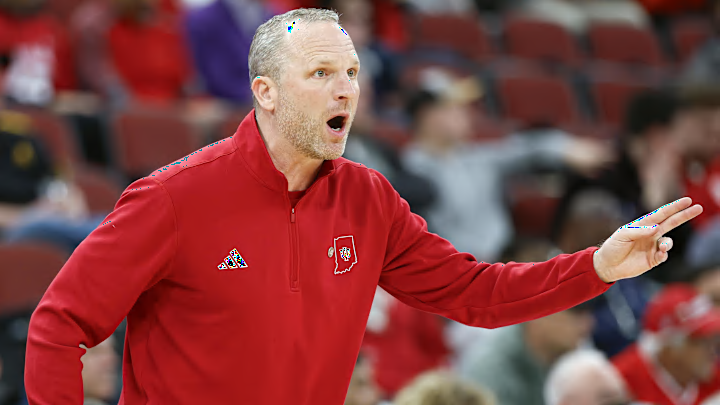
The latest trends in college basketball are pushing every team to get bigger, and last season, Darian DeVries was behind the curve. Even with great shooters in Tucker DeVries and Lamar Wilkerson, the Hoosiers weren’t up to the physical challenge the Big Ten presented.
However, DeVries has seemingly recognized his mistake, and just over a week into the Transfer Portal window, he’s just about fixed it. With six incoming transfers and potentially more on the way, Indiana can match college basketball’s new supersized superpowers, and DeVries's ability to recognize and issue and fix it right away should have Hoosier fans very hopeful for the future.
Indiana needed to add size, so DeVries got some and may have more on the way
With the growing consternation about the possible death of Cinderella in March Madness, the primary suspect has been NIL and the Transfer Portal. Certainly, it makes sense that the talent would funnel upwards from the mid-major programs, with the rich getting richer all the time. However, there is another theory, not one that absolves NIL and the Transfer portal, but it's certainly an accessory to the crime.
College basketball is bigger than ever. About 10 years ago, the three-point revolution swept through the sport as everyone finally realized that three is worth more than two, and teams analytically maximized their offenses. However, then, most of the best three-point shooters were smaller guards, so small-ball lineups proliferated, and with the inherent statistical variance that accompanies a high three-point attempt rate, we suddenly saw 16-seeds taking down No. 1s, and as many upsets as ever.
Of course, this led to another evolution. First, bigger players learned to shoot threes earlier and were ready to do it upon arrival in college. Then, coaches recognized that while three is more than two, the most efficient shot in basketball is still at the rim. So, Todd Golden, Dusty May, and so many others supersized their lineups to maximize rim attempts, rim protection, and rebounding, and increase possessions.
DeVries is willing to adapt, and that’s an underrated skill
DeVries was late to the party. Last year, Indiana ranked No. 14 in the country in three-point attempt rate (per CBBanalytics.com), which isn’t inherently bad, but when accompanied by the 300th-best offensive rebound rate in Division I and the 251st most points in the paint per game, it’s a sign of a massive issue. But an issue DeVries has already addressed.
Sherrell spent most of his sophomore year at Alabama playing center, and as an elite rim protector with a proficient three-point shot, he can be a great stretch five at 6-foot-10. However, his best minutes came playing next to another big, and with Yigitoglu at center, he often will. At 7-foot-2, Yigitoglu is an elite offensive rebounder, with a 95th-percentile offensive rebound rate. When he was on the floor this year, opponents averaged only 14.3 field goal attempts at the rim per 40 minutes, a 93rd-percentile defensive rate.
If Indiana pulls through in its pursuit of Saint Mary’s transfer Paulius Murauskas, one of the top power forward transfers in the nation, Sherrell will always share the floor with another reliable big. Plus, DeVries will have the size and shooting to pull off a three-big lineup, which Florida and Michigan both weaponized on championship runs.
DeVries didn’t lead Indiana back to the tournament in Year 1. However, his first full offseason in Bloomington deserves high marks so far because he’s willing to adapt to the modern game and is leveraging Indiana’s resources to build one of the better rosters in the country to fit the current meta.
 Add us as a preferred source on Google